 GRIEVANCE


Community medicine University exam results 2025 Nov
3 students got distinction
Passed - 99
Failed - 1
Photos of workshop/activities/dept:
-
World health day QUIZ 2016


2. Deaddiction Awareness Rally 2022

3. 24 hr fever opd activities 2022


4. Public lecture – Hand hygiene, monsoon disease awareness at kammavar college - 2022


5. Rally - Monsoon diseases – preparedness, prevention and management – 23.08.2022

6. Medical exhibition - Monsoon diseases – preparedness, prevention and management – 23.08.2022 – all – medical students, nursing students - DGNM and Bsc (N)


7. District Exhibition by collectorate – 2022

8. World heart day rally - 2022


9. Workshop on medical PUBLICATIONS – 5 JULY 2023


10. CEP on "Unlocking Cardiac Care: Advances in Biomarker Testing" -
A Continuing Education Programme (CEP) jointly conducted with Department of biochemistry - 15 December 2025


11. As part of the Veterinary College curriculum, the Department of Community Medicine conducted an academic session for veterinary students on zoonotic diseases, complemented by a practical demonstration of the Epidemiological Surveillance Portal.


12. District Medical Officers - Sensitisation CEP AVIAN INFLUENZA (H5N1) From Birds to Bedsides – Preparedness Begins with Knowledge - 18th February 2026. Click here to see the pdf file.
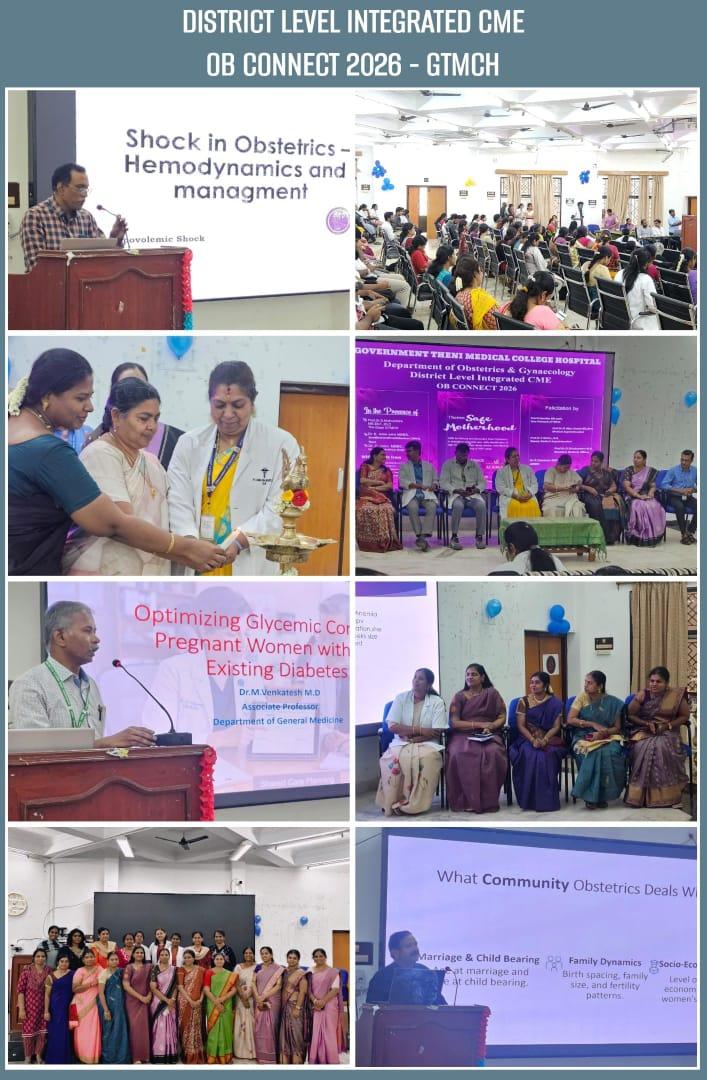
13. HOD, Department of Community Medicine, Dr. Thiruvenkadam delivered the inaugural session talk during the “District-Level Integrated CME – OB Connect 2026” on March 18.
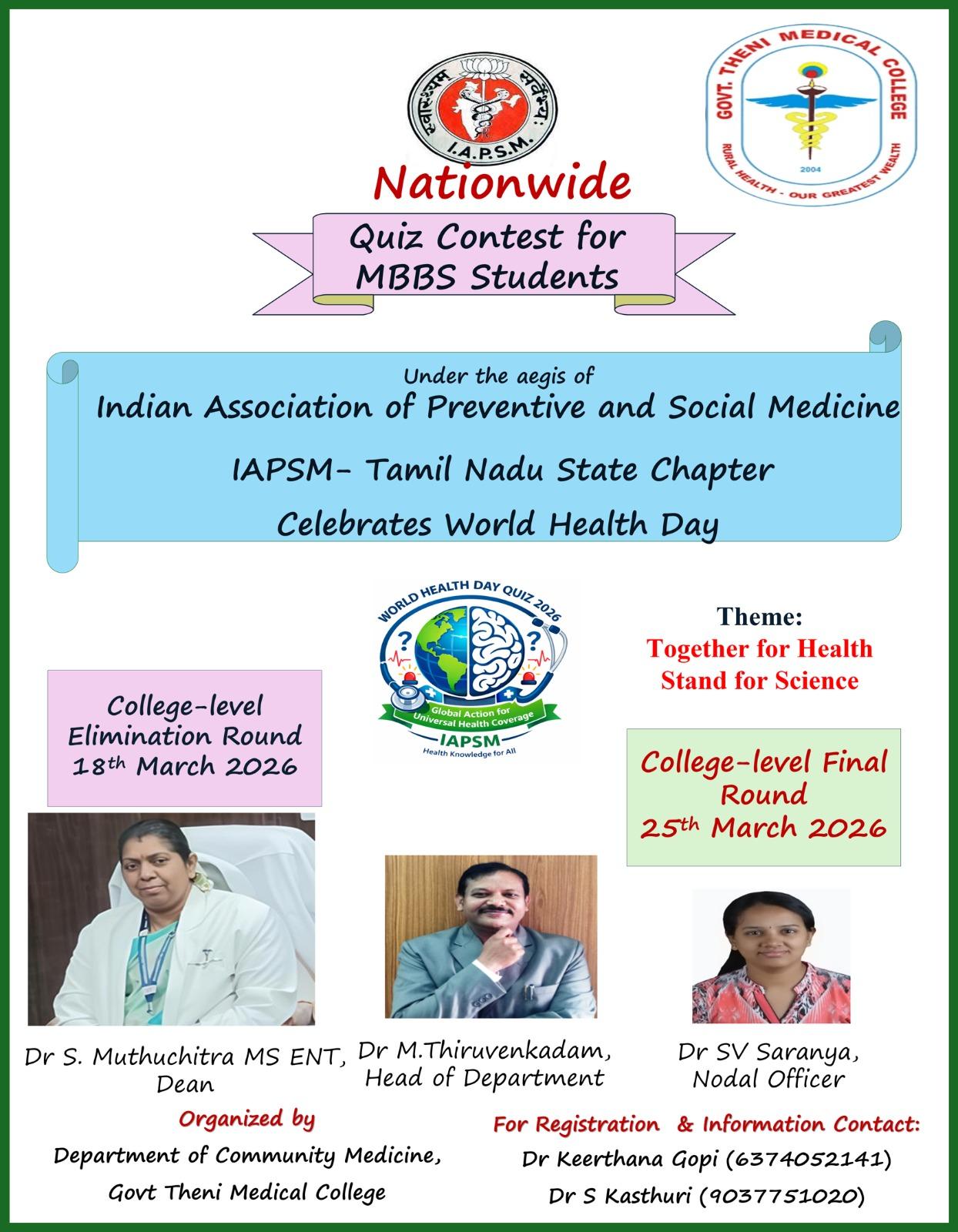
14. IAPSM Tamil Nadu Presents: National Medical Quiz 2026
HEALTH EDUCATION & AWARENESS ACTIVITIES
The Department of Community Medicine, GTMCH, has been conducting regular health education and awareness programmes—including Information, Education & Communication (IEC) and Behaviour Change Communication (BCC) activities—in and around the campus, with the support of CRMI (Compulsory Rotatory Medical Internship) interns, since 2016.
The following activities are carried out across various OPDs and service points at GTMCH:
• Paediatrics OPD
• Antenatal Care (ANC) OPD
• Postnatal Care (PNC) OPD
• Anti-Retroviral Therapy (ART) OPD
• Thoracic Medicine OPD
• Family Welfare OPD
• Immunization OPD
• Breast Milk Bank
MAKKALAI THEDI MARUTHUVAM (MTM)
The Makkalai Thedi Maruthuvam (MTM) programme was launched at GTMCH on 21 September 2021.
https://tgmchen.ac.in/public/upload/6a5a03c7e9226.pdf
MTM is an umbrella programme that collaborates with other major specialties to provide screening and treatment for the following diseases and conditions:
DEPARTMENT OF COMMUNITY MEDICINE — COLLABORATING DEPARTMENT
• Hypertension — Department of General Medicine
• Diabetes Mellitus — Department of General Medicine
• Oral Cancer — Department of Dentistry
• Breast Cancer — Department of General Surgery
• Cervical Cancer — Department of Obstetrics and Gynaecology
• Chronic Obstructive Pulmonary Disease (COPD) — Department of Thoracic Medicine
• Tuberculosis — Department of Thoracic Medicine
• Leprosy — Department of Dermatology, Venereology and Leprosy
• Blindness and Visual Impairment — Department of Ophthalmology
• Chronic Kidney Disease (CKD) — Department of Nephrology
• Pain and Palliative Care — Department of Anaesthesia
• Padham Padhukappom Thittam (Foot Care Programme) — Department of General Surgery
Following intensive community surveys, the findings highlighted the need for greater emphasis on cancer screening.
MTM–OCS (ORGANIZED CANCER SCREENING PROGRAMME)
The Organized Cancer Screening Programme (MTM–OCS) was initiated by the Government and implemented in a phased manner across all directorates. Theni district was included among the Phase 1 districts in Tamil Nadu. A Virtual Tumour Board was formed with the participation of all stakeholders across all three directorates.
ROLE OF CRMI INTERNS
Under MTM, CRMI interns conduct health education, lifestyle modification counselling and Behaviour Change Communication (BCC) activities focusing on diseases and conditions covered under MTM, as well as other community health priorities.
OUTCOME
Through these initiatives, the Department strives to strengthen community awareness, facilitate early diagnosis, promote healthy lifestyle practices and improve public health outcomes, while simultaneously fostering the practical skills, communication skills and community orientation of CRMI students.
A Training on Clinical Management of Acute Febrile Illness and Dedicated Fever Wards
A training session on “Clinical Management of Acute Febrile Illness and Dedicated Fever Wards” was conducted for DPH and DMS Medical Officers at the Office of the District Health Officer (DHO), Theni, on 19 August 2026, during the afternoon session.
The session was conducted by Dr. M. Thiruvenkadam, M.D. (Community Medicine), HOD (I/C), Department of Community Medicine, Government Theni Medical College and Hospital, Theni.
Key Areas Covered
-
Preparedness for Fever Wards and Fever Cases
Planning and preparedness for managing fever wards and patients presenting with acute febrile illnesses.
-
Epidemiological Importance
-
S-form, P-form, and L-form.
-
House Index.
-
Container Index.
-
Previous trends in fever cases, including dengue.
-
-
Preventive and Control Measures
-
Importance of source reduction.
-
Antilarval measures.
-
Fogging.
-
Biological control of vectors using Gambusia fish.
-
-
Clinical History and Investigations
-
Relevant clinical history and investigations based on the duration of fever.
-
Importance of a basic hemogram at the Primary Health Centre and Government Hospital levels, including:
-
Hemoglobin levels.
-
White blood cell count.
-
Platelet count.
-
Hematocrit levels.
-
-
Patients should not be transferred solely for investigations.
-
Bedside investigations help reduce mortality.
-
Bedside investigations and ultrasound are mandatory in critical care units.
-
The 3 Cs of Patient Management
-
Close monitoring.
-
Continuous monitoring.
-
Critical care.
Critical Care and Early Referral
The session emphasized the importance of critical care, early referral, and recognizing warning signs requiring timely intervention.
The following parameters should be carefully assessed:
-
Urine output: 1 ml/kg of body weight.
-
Hemoglobin levels.
-
Hematocrit levels.
-
Feeble pulse.
-
Narrowing pulse pressure.
-
Ultrasound findings, including:
-
Pleural effusion.
-
Pericardial effusion.
-
Peritoneal fluid.
-
Free fluid in the abdomen.
-
Gallbladder thickening.
-
Inferior vena cava diameter.
-
The diameter of the inferior vena cava should be assessed to determine the need for intravenous fluids and fluid resuscitation.
Pediatric Fluid Management
In pediatric patients, fluid management should be calculated based on the expected weight for the child’s age, rather than the actual weight.
Example: If a child’s expected weight is 30 kg, but the actual weight is between 40 kg and 50 kg, fluid requirements should be calculated using 30 kg.
For fluid replacement in dehydration, oral fluids should be preferred over intravenous fluids, depending on the patient’s condition.
Mandatory Investigations for Fever Cases
For all fever cases, the following investigations are compulsory:
-
Hemoglobin.
-
Hematocrit.
-
Platelet count.
These values should be compared with baseline levels to facilitate better case management and assess plasma leakage.
During the afebrile phase, the reversal of excess fluid from internal organs into the extracellular fluid compartment should be monitored. Assessment of hemoconcentration and inferior vena cava diameter is important for determining when to stop fluid resuscitation and preventing fluid overload and failure.
A fall in hematocrit of more than 20% from the baseline should be treated with caution.
Double Infections and Sepsis
Possible double infections include:
-
Dengue with leptospirosis.
-
Dengue with scrub typhus.
A patient admitted with dengue may initially present with leukopenia. Dengue fever usually subsides around the fifth day.
If fever continues beyond five days, double infection or sepsis should be suspected.
A repeat hemogram after the fifth day showing leukocytosis is an indication to start doxycycline.
Causes of Dengue-Related Death
-
Dengue-related deaths most commonly occur due to hypovolemic shock.
-
When fever persists for more than 5–7 days, death is commonly associated with septic shock.
Lessons Learnt from Previous Epidemics and Published Literature
Lessons were discussed from previous epidemics during 2012–2014, including outbreaks in Melur and Kadaiyanallur, along with findings from renowned literature and journals.
-
Avoid unnecessary initiation of intravenous fluids in fever cases.
-
When fluid resuscitation is required, prefer normal saline (NS) over Ringer’s lactate (RL).
-
Colloids and crystalloids have a minimal role in most cases.
-
A platelet count below 20,000 in adults or below 10,000 in children may warrant fresh frozen plasma.
Importance of Discharge
-
Avoid early discharge.
Discharge Protocol
Discharge should be considered only after a minimum of 48 hours in the afebrile phase.
Before discharge, the patient should:
-
Be conscious, alert, and oriented.
-
Show improvement in appetite and oral intake.
-
Be able to tolerate and continue routine feeds adequately.
RESEARCH GRANTS / WORKS / PUBLICATIONS
Completed research works
- ICMR-STS-Student project – student Sahithiya
ICMR – STSID: 2022-08059
A descriptive cross sectional study on knowledge, attitude, self-reported practices and barriers towards bio-medical research among undergraduate students of a medical college in south india.
- ICMR-STS-Student project -Student Name- Rithik Sandron (STS-2023-10668)
Guide Name: Dr.Veerakumar
Evaluation of Renal impairment using estimated glomerular filtration rate among type 2 diabetic mellitus patients in South Tamilnadu, India – A Cross-sectional study
Completed Got B+ Certificate in 2024
Ongoing research works
- Dr.Veerakumar: Non-communicable diseases (NCD's) - risk factors surveillance among adult population (18-59 years) in Theni district, southern Tamil Nadu under MDRU project.
Research publications
- Thiruvenkadam Masilamani. Prevalence of Hypertension among 20-40 years in rural population Veerapandi. Journal Of Medical Sciences And Clinical Research (JMSCR), 2018, p684-689.
- Thiruvenkadam Masilamani. Prevalence of Hypertension among 20-40 Years in Urban Population Periyakulam. International Journal of Medical Science and Advanced Clinical Research (IJMACR), 2018. p18-23
- Prabhakar, R., Masilamani, T., & Ananthan, V. Self-directed learning readiness among II and III MBBS students in a tertiary teaching hospital. Int J Com Med Public Health, 2020. 7(11), 4584-4591
- Saranya SV, Kumar A, Kulkarni MM, Kamath A. Perception, awareness and utilization of integrated child development services scheme by mothers in coastal Karnataka, India. Int J Community Med Public Health 2022;9:2639-43
- Sivanesan S, Kumar A, Kulkarni M M, Kamath A et al. Do adolescent girls of Coastal Karnataka, India have Knowledge of Integrated Child Development Services (ICDS) Scheme? What is their perception and utilization rate? – A cross sectional study. Volume 13 Issue 3 July-September 2022
- Sivanesan S, Rao CR, Mallya SD, Kumar U, Kamath A. Descriptive analysis of sleep quality and its determinants among rural population of coastal Karnataka. Indian J Community Health [Internet]. 2022 Dec. 31 [cited 2023 Apr. 27];34(4):554-9. Available from: https://www.iapsmupuk.org/journal/index.php/IJCH/article/view/2420.
- Ananthan VA. Viral genome sequencing for Defining Re-infection with COVID-19. J Family Med Prim Care. 2021 Mar;10(3):1499-1500.
- Ananthan VA. Modified Kuppuswamy scale for socioeconomic status of the Indian family- Update based on New CPI (IW) series from September 2020. J Family Med Prim Care. 2021;10(5):2048-2049.
- Venkatesh U, Sharma A, Ananthan VA, Subbiah P, Durga R; CSIR Summer Research training team. Micronutrient's deficiency in India: a systematic review and meta-analysis. J Nutr Sci. 2021 Dec 21;10: e110.
- Velmurugan A. Modified BG Prasad socioeconomic scale classification update based on New CPI (IW) series from September 2020. NJRCM 2020;9(1):129-131 5.
- Velmurugan A, Veerakumar AM, Parameshwari P. COVID-19: Filling the Gaps In the Natural History of the Disease for Controlling the Pandemic. NJRCM.2020. 9(2): 061-066.
- Venkatesh U, Aravind GP, Velmurugan AA. Telemedicine practice guidelines in India: Global implications in the wake of the COVID-19 pandemic. World Med Health Policy. 2022 Sep;14(3):589-599. doi: 10.1002/wmh3.497. Epub 2022 Feb 21. PMID: 35601469; PMCID: PMC9111269.
- Velmurugan A, Ramola K. A cross sectional study on systemic hypertension and its relationship with Waist to Stature ratio (WSR) in an urban population in Chennai. NJRCM. 6(2): 124-131.
- Murugan K, Ananthan VA, Veeranan A. A cross - sectional hospital-based study on correlation between serum uric acid levels and disease activity in recently diagnosed rheumatoid arthritis in Chennai, Tamilnadu. J Evid Based Med Healthc 2021;8(38):3372-3377.
- Veerakumar A M, Velmurugan A Treatment seeking behaviour of animal bite among a rural population in Trichy district: A cross sectional community-based study. Nat.J.Res.Com.Med. 2020; 9(4).
- Veerakumar A M, Velmurugan A. Self-medication practices in a rural population in Tamil Nadu. Int J Community Med Public Health. 2020; 7 :5021-6.
- Ramanathan P, Prabhakar R, Ananthan VA. Perception of social stigma among patients attending a filariasis morbidity control clinic in South India. Int J Community Med Public Health 2020;7:4604-8.
- Ramanathan P, Prabhakar R, Ananthan VA. A cross sectional study on musculoskeletal discomfort and its determinants among agricultural workers in a rural community of Tamil Nadu. Int J Community Med Public Health 2020;7:4839-44.
- Murugan K, Ananthan VA, Geetha SMR, Masilamani V. A Hospital Based Case Control study on Serum Lipid Profile in Patients with Active Rheumatoid Arthritis attending a tertiary care center in Chennai, Tamil Nadu, India. Res J Pharm Biol Chem Sci. 2022;13(4).
- Veerakumar AM, Kar SS. Awareness and perceptions regarding common cancers among adult population in a rural area of Puducherry, India. J Edu Health Promot 2017;6:38
- Kumarasamy H, Veerakumar AM, Subhathra S, Suga Y, Murugaraj R. Determinants of awareness and practice of breast self-examination among rural women in Trichy, Tamil Nadu. J Mid-life Health 2017; 8: 84-8.
- Veerakumar A M, Hemalatha K Mobile Phone Usage and Its Association With Sleep Pattern Among Medical Students, Indian J Applied Research, 2017 Dec; 7 (12): 208-11
- Veerakumar A M, Knowledge of Carcinoma Cervix among rural women of Reproductive age in Trichy district, India, Journal of Comprehensive Health, July 2017; 5 (2): 46-52
- Veerakumar A M , Shanmugapriya D , Shanmugapriya J , Soorya Narayanan B , Subashini S Self-care Activities among Diabetic patients in rural areas of Trichy District,Tamil Nadu, Nat J Res Com Med; Sep 2017; 6 (2): 120-123.
- Viswanathan DJ, Veerakumar AM, Kumarasamy H. Depression, suicidal ideation, and resilience among rural farmers in a drought‑affected area of Trichy district, Tamil Nadu. J Neurosci Rural Pract 2019;10:238-44.
- Venkatachalam D, Selvaraj K, Ramaswamy G, Veerakumar A, Chinnakali P, Saya GK. Are patients satisfied with accessibility and services provided at siddha hospitals? Findings of patient satisfaction survey from a district of South India. Int J Community Med Public Health 2018;5:2596-9.
- Annamalai I, Balasubramaniam S, Fernando ME, Srinivasaprasad ND, Suren S, Thirumalvalavan K, Veerakumar AM. Volume Assessment in Hemodialysis: A Comparison of Present Methods in Clinical Practice with Sonographic Lung Comets. Indian J Nephrol. 2019 Mar-Apr;29(2):102-110. doi: 10.4103/ijn.IJN_78_18. PMID: 30983750; PMCID: PMC6440333.
Title: Cancer Awareness Week – MTM OP Report
Click the PDF below to view the full report:
View PDF – Cancer Awareness Week MTM OP)
Dr.Tamilamudhan:
1.Manivannan, T., & Ayyappan, C. (2024). A study on association between respiratory morbidity and type of work, duration of work among unorganized sector workers in Tamil Nadu. International Journal Of Community Medicine And Public Health, 11(11), 4379–4383. https://doi.org/10.18203/2394-6040.ijcmph2024330.
2. Manivannan T, Maheswari RU, Vasudevan D, Nachimuthu N. A Cross-sectional Study on Prevalence of Cardiovascular Disease Risk among Hypertensive Patients Using the World Health Organization-International Society of Hypertension Chart in Rural Field Practice Areas of a Medical College, Chennai. J Midlife Health. 2025 Jul-Sep;16(3):267-271. doi: 10.4103/jmh.jmh_1_25. Epub 2025 Sep 5. PMID: 40951858; PMCID: PMC12431693.
3. Manivannan, T., Chandrasekar, J. P., & Vasudevan, D. (2025). Machine learning based prediction of risk of hypertension among people of Tamil Nadu. International Journal Of Community Medicine And Public Health, 13(1), 402–405. https://doi.org/10.18203/2394-6040.ijcmph20254454
4. Ram AA, Vijayakumar M, Manivannan T. Future trend of gynaecological malignancy in Tamil Nadu – a forecasting analysis. Int J Toxicol Pharmacol Res. 2025;15(1):124–129.
5. Tamilamudhan M, Subramaniam S. Spatial autocorrelation of breast cancer incidence and its relation with human development index in Tamil Nadu: an ecological study. Tamil Nadu J Public Health Med Res. 2023;3(3):11–13.
Dr. Jayabharathi P.C.
- Jayabharathi PC, Sudharshini S. IJCM_157A: Knowledge, attitude and disposal practices of unused and expired medicines among general public in Kundrathur primary health centre area of Madras Medical College. Indian J Community Med. 2024 Apr;49(Suppl 1):S46. doi: 10.4103/ijcm.ijcm_abstract157. PMCID: PMC11155979.
- Manivannan, T., Chandrasekar, J. P., & Vasudevan, D. (2025). Machine learning based prediction of risk of hypertension among people of Tamil Nadu. International Journal Of Community Medicine And Public Health, 13(1), 402–405. https://doi.org/10.18203/2394-6040.ijcmph20254454
CME / CONFERENCES / ACADEMIC ACTIVITIES
|
Sl No |
Programme |
UG / PG |
Date |
|
1) |
CME - Updates on immunization |
UG |
3 April 2019 |
|
2) |
CME - Monsoon diseases – preparedness, prevention and management
|
UG
|
23.08.2022
|
|
3) |
CME – World Heart day |
UG |
29.09.2022 |
|
4) |
Workshop on medical publications |
Faculty, PG and UG |
05.07.2023 |
Other activities:
- FAP – Family adoption program for MBBS students as per NMC and university guidelines
- Field visits
- Nursing classes
- Paramedical classes for B.Sc. MLT
DEPARTMENT OF COMMUNITY MEDICINE, GTMCH
SUMMARY OF FAP MEDICAL CAMP
Total examined-55 Male-15, Female-40 Age group:
15-45 years-17; 46-60 years-20; >60 years- 18 NCD screening:
|
Screening |
Total screened |
Raised BP/ Deranged RBS |
K c/o DM/HTN |
|
Bloop pressure |
55 |
17 |
13 |
|
GRBS |
54 |
9 |
9 |
Women with BMI-Underweight: 4 Men with BMI Underweight: 2
Women with BMI Overwt/obese(≥25mg/m2): 13 Men with BMI Overwt/obese(≥25mg/m2): 5 Women WHR≥0.85 : 19
Men WHR ≥0.90: 12
Non pregnant women 15-49 years anemic HB<12g/dl: 30 Men with high GRBS 141-160mg/dl: 1
Mwn with very high GRBS > 160mg/dl: 1 Women with high GRBS 141-160mg/dl: 3 Women with very high GRBS >160 mg/dl: 4
Women with mild elevated BP (Systolic 140-159/ Diastolic 90-99 mm Hg): 2
Women with moderate/severely elevated BP (Systolic≥160, Diastolic≥100 mm Hg): 4 Men with mild elevated BP (Systolic 140-159/ Diastolic 90-99 mm Hg): 4
Men with moderate/severely elevated BP (Systolic≥160, Diastolic≥100 mm Hg): 1


